Manipulation
This section focuses on practical robot-arm workflows, showing how perception, pose estimation, motion planning, and control are connected to let a robot interact with objects.
While Robotics explains how a robot senses, perceives, plans, and acts, Manipulation applies those concepts to tasks performed by a manipulator, such as reaching, picking, placing, and stacking objects.
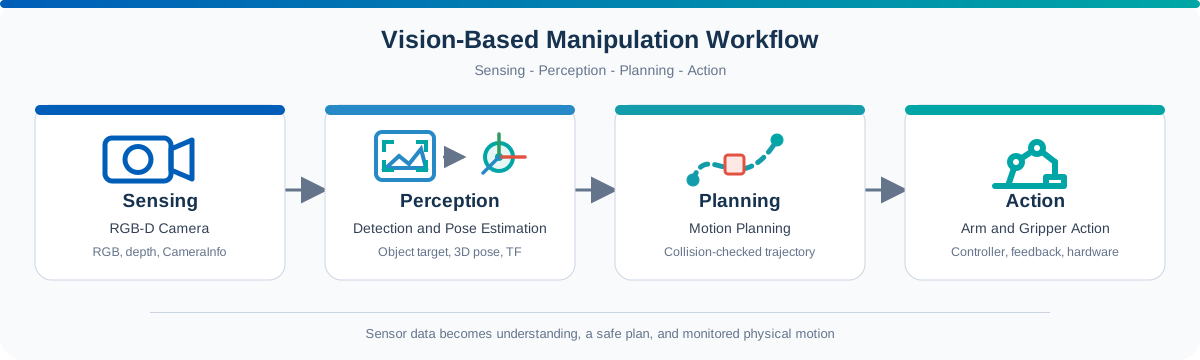
Manipulation Workflow
A typical vision-based manipulation workflow contains the following stages:
-
Object Perception
Detect the target object from RGB or RGB-D camera data. -
Pose Estimation
Estimate the object's 3D position and orientation in the camera frame.
Transform the detected pose into the robot's planning frame, typically the robot base frame. -
Motion Planning
Generate a valid robot-arm trajectory to the target using a planning framework such as MoveIt. -
Arm Action
Send the planned trajectory to the robot controller, monitor execution, and coordinate the gripper when required.
What You Will Learn
- How camera perception is connected to robot-arm applications
- How RGB, depth, and camera calibration are used for 3D position estimation
- Why camera-to-robot calibration and TF are required in a complete system
- How object poses become motion-planning targets
- How URDF, joint states, TF, MoveIt, and robot controllers work together
Hands-on Samples
Manipulation topics are paired with teaching-oriented examples and recorded ROS bags, allowing you to:
- Observe perception results and robot-arm motion without connecting a physical camera or manipulator
- Understand the relationship between object detection, pose estimation, motion planning, and robot action
- Study repeatable workflows before adapting them to your own camera, robot model, and controller
Manipulation bridges the gap between robot perception and physical interaction with the environment.